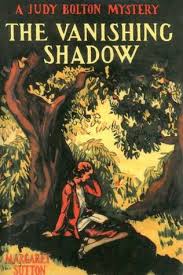
 The Vanishing Shadow (Judy Bolton #1)
Margaret Sutton
Grosset & Dunlap, 1932
Genre:
Realistic, Mystery
Description
Judy is from Roulsville but is spending a part of her summer
with her mother's parents. As the book opens, she and her friend, Edna, are
watching some construction men build a new road for the town of Dry Brook Hollow. As she
watches, she sees two men get yelled at by the overseer. They back down and
Edna calls them sissies like Horace (p. 4). Judy does not like Edna calling her
brother names since as a child he was very, very sick and very timid.
When Judy gets home she discovers that she has received a
letter from an unknown sender. It encloses 10 tickets to a dance and a spelling
bee. The only other thing it contains is a small slip of yellow paper with a
cross on it. Judy thinks she has two mysteries on her hand. Who sent the
letter? And what about the argument the construction men were having about a
dam that was recently built and a “pit” they don't want anyone to know about?
Judy really wants to go to the dance and the spelling bee and hopes that her
grandma can lend her some of the money her father had left her and Horace for
the summer. However, she finds out that her grandmother has gone and given all
of that money to Horace for him to buy a new suit.
Angry, Judy heads back to the grove to find one of the angry
men from before there waiting for her. He tries to bribe her to keep quiet
about what she heard them arguing about by giving her a pearl necklace. She
refuses and realizes that what she heard about the dam and the pit must be
important. As she is walking home a number of questions fill her mind. She sees
an odd shadow and believes she sees someone disappear into some bushes. She
tries to follow the shadow which eludes her and she eventually sees Horace. She
calls out but he doesn't hear her and she suddenly finds herself grasped from
behind by a strong arm that puts a bag over her head. Her hands are tied
together and she is thrown into the backseat of a car.
She hears one man say that they've got to get rid of Judy.
They take her to a place and keep her there until they decide how to fix the
problem. She once again hears them say something about a dam and how no one can
find out about it. She listens around her and hears sounds like roaring water
and wooden planks the men walk on. They unlock a door and dump her on the floor
of what appears to be shed. She also hears insistent hammering. The men untie
her and say that they will see her in the morning. Judy searches the room and
finds no way out. She wonders where the heck she's been brought.
In the morning she attempts to look out the keyhole but a
chair has been propped up blocking her view. She hears a dog in the distance
and tries calling to it but it sounds mean when he growls back. Soon she hears
footsteps approach the shed. The man talks to her and says that she must make a
promise that she won't repeat any of the conversation she overheard the day
before. Judy attempts to word her promise in such a way that she could expose
them later without truly speaking about it. She asks the men to take her to her
house in Roulsville so no questions will be asked about her disappearance. She
falls asleep in her father's office and three hours later Horace and her
grandfather find her. Horace thinks his selfishness is what caused Judy to run
away.
The next Sunday Judy and Horace go out for a picnic. Horace
is surprised to see the brook is dry. Each year for years and years every
summer it would go dry but then about 25 years ago it stopped refilling and no
one knows why so that is why the town is called Dry Brook Hollow now. Judy
persuades Horace to try to locate the head of the brook. Judy stands on some
tall rocks and discovers what appears to be a stone quarry in the distance that
they've never seen before. As she looks at the surroundings she begins to
discover other weird things, such as a hill that splits into two and in one
direction a slanting rock with falling water that is new and a muddy trail that
appears to have been an older brook. They decide to investigate and discover an
area that is not very pretty. It is all muddy and appears as if someone was
digging there. The spring appears to have been tampered with. The water is the
color of dirt and the brook is nearly all but gone. Judy discovers what appears
to be a mini dam constructed and realizes that someone has purposely changed
the course of Dry Brook. Could this be the dam that the men were talking about?
Later that night Horace presents Judy with a dress,
necklace, shoes, and stockings along with one dollar for her entrance to the
spelling bee. She refuses to keep the dollar saying that she will try to sell
blackberries to earn her own money. She is shocked to learn that Edna already
has a ticket to the dance and spelling bee because Charlie Austin, a well-known
businessman in the area, asked her to go with him. Edna shows Judy the dress
that she will wear to the event and admits that she got money for it from a
strange man who wanted her to keep quiet about what she Judy had overheard. All
of a sudden Judy puts two and two together and realizes that Charlie, the new
manager of the paper mill in town, is quite possibly the instigator of this
plot as he certainly has the money for the bribes.
Later that day as she attempts to make her way back to the
head of Dry Brook, she finds an alternative path with a new road and discovers
tire tracks. She luckily finds the miniature dam and undigs it so that the
brook will run naturally again. She then picks are berries that she will sell
the next morning. In the morning, she puts part two of her plan into action.
She believes that the president of the paper mill will be interested to know
that a trusted official is actually a treacherous criminal. As Judy heads into
town her horse gets scared by the local train and she falls off. She is helped
by Peter Dobbs, the grandson of the president. He informs her that his
grandfather is no longer president of the paper mill and that he is retired and
sold his shares. The new manager is a man named Mr. Rubin who basically gives
all of the work to Charlie. Peter doesn't like him and says that his grandfather
wouldn't have ever sold if it weren't for that scoundrel. Judy decides to let
Peter in on the plot she has discovered. When Judy meets Peter's grandfather
she discovers that he is the man who sent out tickets to everyone. One mystery
solved!
Peter offers to accompany Judy to the paper mill. They stop
by the new dam and Judy sees her horse in the fields. As she walks up to him
she begins sinking ankle-deep into the grass and she instantly remembers the
squishy sounds that her captors' feet made. Could the mysterious pit be located
somewhere around here? She discovers a shack in the distance and instinctively
knows that that was where she was kept. At the paper mill she tries to see Mr.
Rubin but the man's mean secretary says that Mr. Austin will see her instead.
She escapes but runs into him outside.
At home Judy tells her grandfather about the spelling bee
and he informs her that he needs both of his horses all day long Friday. She has
to stay home because he can't take her. Judy, being determined not to miss the
dance or the spelling bee, decides that she will walk all the way to town. On
her way a car holding Arthur Farrington-Pett and his friends Lois, Lorraine
Lee, and Donald Carter are driving by and offer to give her lift. Arthur wants
to make a pit stop at the mill to see Austin or Rubin. He is an engineer and
stated that he originally wanted the contract to build the new dam but the
company didn't give it to him. The construction company that did win the bid
was so low hisis pretty sure there's something crooked going on and he believes
that the dam is not as strong as it should be.
Judy enjoys herself at the dance and participates in the
spelling bee. The competition goes for a very long time until it is just Mr.
Dobbs versus Judy. Judy goes on to win and receives $10 in gold. Later Judy and
Arthur talk about their mutual distrust of Austin. Judy mentions the mysterious road she
found in the woods and Arthur says that it might lead to this mysterious pit.
Judy is shocked that he appears to know what this pit is. He says that he knows
that the construction was built out of low-quality sand to build the dam and
must've come from a natural pit instead of a building supplies company. Judy
also tells him that she discovered the brook was dammed up and is shocked to
hear Arthur say that he is glad someone did it because the brook is dangerous.
On their way home, Arthur points out cracks in the dam's foundation and how
they appear to be getting larger by the day. Arthur says that a man at the
gravel works said that no sand was purchased for the construction of the dam
which is what leads him to believe that there is an old sandpit somewhere in
the hills. That sand is not safe to build the roads let alone large dams. He is
worried that the dam will break and flood the valley. Judy has learned a lot of
information and is horribly confused. If Charlie dammed the brook why is he
acting all shifty? Judy needs to undo her work ASAP.
The next morning she sets out in an attempt to stop up the
brook again. Horace wants to help Judy so she tells him to deliver a note to
Peter. Judy warns him not to look at it or let anyone else have it. He is only
to read it if he cannot deliver the note to Peter. On his way to the church in
Roulsville, Horace passes the dam and sees the crack in the side has gotten
larger and the little shack below the dam is now standing in water. After the
church service, Horace learns that Peter is not home. He decides to read Judy's
note. He learns that Judy promised not to talk
about what she heard but had said nothing about writing it down and the letter contains all the information about
her abduction. She asks for Peter's help to try to re-stop the brook.
Right then the atmosphere changes. A big storm is coming. It
begins to pour and lightning strikes. Horace hears what sounds like thunder but
realizes somehow that he knows that the dam has just broke. Instead of running
to safety or becoming a scaredy-cat like everyone would expect, Horace calls
out to everyone that they need to evacuate the valley.
Back at home Judy sees the water of Dry Brook running
swiftly and she knows that it is too late to stop it. She suddenly sees lots of
cars rushing toward Roulsville with the exception of one which happens to be
driving to the safety of Farringdon—Charlie Austin's car. Judy decides to head
down to see if she can help in the wake of the disaster. As she walks the miles
she finally sees the dam now broken into three large pieces. The pieces have
crushed the paper mill. Judy finds everyone on top of the hill out of harm’s
way and learns that they were all saved by Horace and that they consider him a
hero. The only person that they know is dead is Mr. Rubin who was inside the
paper mill. Judy runs into Peter and they decide to brave the waist high water
and attempt to walk to the other side of the valley to find Horace. They
unfortunately can't make it past the river but a man signals to them that
Horace is not there. Judy and Peter see their houses—or what remains of them.
They decide to search the woods and they run into some policemen who are
looking for a man named Christopher White. This man was in charge of building
the dam and Judy realizes that he's the man who helped kidnap her. In the woods
they find Ginger, the horse that Horace was riding. A little ways away they
find Horace who was just a bit dazed.
Horace tells Judy not to feel guilty. Dry Brook wouldn't
have stopped the dam from breaking. The media want to interview Horace later
that night because he is the hero that saved everyone. He confesses to the
press that he was scared and just lost his mind but no one seems to care. He
says that Judy is the real hero and ends up spilling the story of her
kidnapping. The police admit to holding Austin
for questioning because of a mysterious phone call they received warning them
of his behavior. Judy admits to making that call when she saw him leaving town.
The Rite-Way Construction Company, the ones who built the dam, are already out
of business, their offices abandoned. White is still missing. The police decide
to bring Charlie to Judy's house because he won't talk to them. She mentions
how he tried to blackmail her and he loses his temper and accuses her of
squealing which gives the police enough evidence. Judy takes a closer look at Austin and notices a few
unusual things. She tells the cops to remove his black hair, rub off his
penciled eyebrows, and remove his makeup. In doing so they discover that
Charlie Austin is really Christopher White.
Judy's father tells her that she will have to be available to
testify and that she will have to talk about how she unblocked Dry Brook
because that proves that Charlie knew about the dam being unsafe.
Horace has received a number of gifts from the townspeople.
Not wanting to take anything from anyone he tells Judy to open them all and
return them to their owners. Judy does just that but decides to keep one. A Mr.
Vincent has offered them a rent-free house in Farringdon. Since their house was
destroyed she really can't refuse such a generous offer. It is a house located
at 1365 Grove Street.
Lois knows exactly how to convince Judy's family to move when she tells them
that the reason Mr. Vincent can't rent it is because it is supposedly haunted.
Horace decides that he will accept the house since it is clear no one else is going
to use it and maybe encountering a ghost will be exciting.
Thoughts and
Nuggets of Wisdom for Research
Judy Bolton is considered by many series book collectors to
be the archrival of Nancy Drew. Written by a real person (and not a
ghostwriter) the series is often considered of higher literary quality and Judy
could be an independent girl not having to bow to a Syndicate’s ideas of what
was prim and proper for young ladies of the 1930s.
Judy’s spirited attitude is seen early on when her
grandmother complains that it is “about time you learned to help without being
asked. . . . Now when Horace is here I don't have all this work to do alone. He
always helps just like a girl” (p. 8).
Her grandmother is also the epitome of old-fashioned values.
In the act of taking the money that Judy’s father left for them to enjoy over
the summer and using it all to buy Horace a new suit, she lets Judy know just
how unimportant a young girl is compared to a young man (p. 9-11):
“That's all gone,”
her grandmother interrupted. “Horace wanted a new suit and I gave it to him.
His salary’s got to be kept for college and he needs to look nice if he's going
to be a successful newspaper reporter. Now what are you sniveling about?” . . .
“Oh, no,” she
retorted, her eyes flashing, “I never had any use for new clothes. It's always
Horace. It's his silly ideas of right and wrong that influence the whole
family.”
“He's a conscientious boy, my dear,” her grandmother chided.
“Conscientious nothing! It's because he’s a weakling himself
and hates to see other people enjoying themselves. That money was partly mine
and he had no right to take it. Any boy with an ounce of courage would've
refused it. You had no right to give it to them either, Grandmother Sneed!” . .
.
Just because he had been sickly as a boy he seems to think
he could dominate the whole family with his ridiculous whims.
There are other instances of Judy’s usual behavior for a
girl:
It had not occurred to Judy, during the night of suspense,
that she was acting courageously and trying to figure things out instead of
giving way to despair. The one thought that preyed upon her mind more than any
other was the fact that while she was in prison she was helpless to defeat the
wicked schemes of her abductors (p. 27-28). (It is interesting to note Judy’s
emotional and self-doubting state here—it is for this reason that she is
considered by many to be a more believable and realistic role model than Nancy
Drew—a character who seems like she can do no wrong.)
“If you're a girl and live in Roulsville you wouldn't be
asking who Charlie Austin is. He drives a sporty yellow roadster and it is
considered a rare privilege to ride beside him. Every girl in high school is
sentimental about him. That is, every girl but myself,” she added as an afterthought.
“I don't fancy his type” (p. 53).
“Sometimes I wish I were a boy.” (Judy)
“And you would be—” (Horace)
“A detective,” she broke in quickly. “A great one who goes
into all kinds of dangers. I wouldn't mind that—afterwards. There would be that
thrill of finding out things. You can't imagine what a satisfaction there is in
hitting on a real-live clue” (p. 53).
“Do you wonder that the girls all have an eagle eye on him?
I suppose there's something unnatural about me, but once I actually turned down
an invitation to go for a ride in his yellow roadster. I feel safer in dad's car
or behind grandpa's horses” (p. 54).
“Gee!” Peter exclaimed after a long silence. “You're a
plucky girl, Judy. Did it ever occur to you that thwarting schemes like that
one might be dangerous?”
“It never occurred to me that it was anything but dangerous.
I like dangerous things” (p. 73).
While Judy is an unconventional girl, those around her are still
pretty typical and Judy herself does a little naughty judging too. When she
discovers that Edna has been asked out by Charlie she thinks to herself, “It
seemed incredulous. Edna Jenkins was about the last girl in the world that a conceited
young spendthrift like Charlie Austin would be apt to choose. She was neither
pretty nor sociable while he was able to mingle with the most charming of girls”
(p. 60). There is also an off comment about Mrs. Dobbs and her household: “Although
in comfortable circumstances, Mrs. Dobbs still did her own cooking. With her it
was an art—something to be attempted only by experts” (p. 78)
Lastly, there is one tiny nod to technological advances of
the car as shown by Judy’s grandfather’s reluctance to move away from horse
drawn carriages. On pages 39-40 we see that Judy’s:
Grandfather still uses horse and carriage as he does not
trust the newfangled cars. Fannie and her colt were hitched to a shiny black
carriage. Judy was never sure whether this vehicle looks old-fashioned and
funny or whether it resembles a modern coach, the kind that men with tall silk
hats drive through the city parks. At any rate, her grandfather insisted that
as long as buggies were to be had, he would never trust his feeble hands
driving an automobile.
Overall, Judy Bolton has been called a better feminist role
model than Nancy Drew because Nancy (especially the revised one) was more apt
to maintain an ideological status quo, while Judy was more likely to focus on restoring
moral order. Also unlike Nancy, Judy Bolton
often enlisted the aid of her family and friends in solving mysteries, whereas Nancy liked to work alone
and begrudgingly accepted “help” from others like Ned and later Bess and George.
There were 38 titles in the original Judy Bolton series, all
written between 1932 and 1967. The final 12, particularly the last one, had
limited printings and as a result are hard to find. Collectors often find
themselves paying upwards of $200 for a volume in good condition. The series
ended before the 39th book, The
Strange Likeness, could be published. (It was finished in 2013!) According
to author Margaret Sutton, the series was killed due not to poor sales but due to
pressure from the Stratemeyer Syndicate, which wished to lessen competition for
the Nancy Drew series.
 Unico
Unico

